June 19, 2026
LSM Visits Samara Karoo Reserve, South Africa
She walked within a metre of us and looked me directly in the eye.
Not a glance. A held, unhurried look — the kind that makes you aware of yourself in a way that very few things do. Her cubs were behind her, four or five of them spilling out from the shade of a low bush tree where they’d been playing, and she was moving past us with a calm so complete it felt almost deliberate. We had been standing in single file in the long grass, following Roelof Wiesner, Samara’s head guide, doing what you do when a guide of his experience tells you where to put your feet. We had stopped. We had watched. And then she rose — this cheetah, this wild and unhurried cheetah — and she walked, and she looked at me, and I looked at her.
I can’t explain what passed between us. I know how that sounds. But there was something in it — some quality of recognition — that I am still thinking about.
She is a descendant of Sibella. This matters, and I’ll come back to it.
Samara Karoo Reserve sits about seven hours northeast of Cape Town by road, 67,000 acres across eleven farms in the Eastern Cape. From the air it looks flat, semi-arid, spare. On the ground, under the Sneeuberg mountains with the plains of Camdeboo ahead of you, the scale of what you are inside starts to register differently.
Sarah and Mark Tompkins began assembling it in 1997, starting with a single property called Apieskloof — Monkey Valley — after a dinner party conversation about what this landscape used to be. What it used to be was extraordinary: one of the largest terrestrial migrations ever recorded, an estimated twelve million springbok moving across these plains, accompanied by elephant, buffalo, black rhino, leopard, and the black-maned Cape lion, absent from this landscape for nearly two centuries.
Then farming arrived. The fences went up. The animals disappeared. The soil compacted under sheep hooves for generations, and that is how things stayed until Mark and Sarah decided, with the particular stubbornness of people who have fallen in love with a place, that it could come back.
There is a cap you are handed when you arrive at Samara. It reads: Dare to Rewild. It takes about three days to understand how seriously they mean it.
Rewilding a landscape of this scale is not a romantic idea. It is permits and ecological assessments and 240 kilometres of internal fencing removed. It is negotiations with neighbouring farmers — some of them fourth-generation — who had never lived alongside a lion, and daily proof of the lion’s location sent by radio for months after reintroduction so that nobody encountered one without warning. It is resting the land for almost a decade and trusting that something is happening underneath, even when you can’t see it.
The lion is here now. So is the elephant, and the rhino, and the cheetah. It required, above everything else, the patience that most conservation projects talk about and very few actually practise. Samara practises it — you feel it in the way the guides move, in what they choose to stop for, in how the days settle around you. It becomes, after a day or two, the thing you take home.
Marnus Ochse, General Manager of Samara Karoo Reserve, talks about the vision with the focused energy of someone who has learned not to be distracted by everything that isn’t the north star. “Our primary objective is to protect and rewild this landscape,” he told me. “The ecotourism, the certifications, the donor funding — those are all vessels. They exist to support that one thing.” Samara joined The Long Run six years ago, a global conservation certification body auditing against four pillars: conservation, community, culture and commerce. What struck me was not the certification itself but how far it reaches — every person on the team, from management to guides to kitchen staff, part of the same understanding of why the place exists and what it is trying to become. “We are all equal parts of this mission,” Marnus said. “If the person preparing your meal doesn’t understand why we compost, why we save water, why we source locally — then we haven’t done our job.”
The rewilding extends well beyond the landscape itself. Ninety per cent of Samara’s monthly expenditure goes into Graaff-Reinet — the local butcher, the hardware store, the carpenter. Boundless, a workshop employing people affected by foetal alcohol syndrome, makes the linen on the breakfast tables. Anneley Swemmer, lodge manager and community projects lead, has run the Samara Heritage Day Cup since 2018 — a sports tournament drawing around 800 children from the surrounding area each year. It started as a way to get children off the streets and became something that the whole region turns up for. These are not footnotes to the safari experience. They are the same project.
The Manor — newly reimagined and the reason for my visit — arrives in stages as you drive in, the mountains behind it, the plains ahead. It feels less like a lodge and more like a very well-considered home: high ceilings, light flooding through open spaces, sumptuous textiles and bespoke pieces inspired by the Karoo’s artisanal heritage, a chessboard in the corner of the living room that nobody seems to be in any rush to finish. Two expansive living areas, reading alcoves, a dining room and a bar that becomes the natural gathering point after a day out. It sits far enough from everything that the outside world stops feeling urgent. Within half a day, the urge to check things quietly loses interest in itself — and you start, slowly, to rewild something in yourself too.
Returning from the morning drive, there was always someone waiting at the entrance — cold towel, welcome drink, the particular relief of both after hours in the open air. Lunches and dinners were quietly, consistently excellent — beautifully curated, deeply of this place. On one slow afternoon, I had a massage in the suite, followed by a bath. I was in no hurry to leave. These are small things. They are also the things you remember.
The far edge of the property during lunch one day belonged briefly to a giraffe — moving with the complete indifference of an animal that has absolutely nowhere to be — and we watched it until it disappeared. The monkeys were less composed — cheerfully chaotic on the lawn throughout the day, more cabaret than intrusion. Earlier on a morning drive, we had come across a giraffe lying down in the grass — something so rarely seen that Roelof quietly noted it before any of us had processed what we were looking at, given they sleep for only around 28 minutes a day in short bursts. It felt like a small gift.
Those drives pull you in every direction, and no two hours look the same. The reserve sits across five distinct vegetation biomes — Nama-Karoo, savanna, grassland, Albany thicket and Afromontane forest — and the terrain shifts completely as you move through it. Dense riverine thicket gives way to open plains, which gave way, on one particular morning, to something I hadn’t been expecting at all.
We were out searching for lion — the tracks faded, the lions made clear they had no intention of being found. After that, we started making our way towards breakfast — up into the hills, the scrub thinning, the air cooling — and at some point, Roelof pulled over, and we got out and walked. He followed at a distance in the Land Cruiser while we moved uphill through the changing landscape until we crested the ridge and stopped.
The Samara Mara. Thousands of acres of plateau grassland, black wildebeest drifting through the long grass, Cape mountain zebra on the far ridge, the whole reserve laid out below in every direction. I had been told about it and still wasn’t prepared for it. We stood there for a while without saying much.
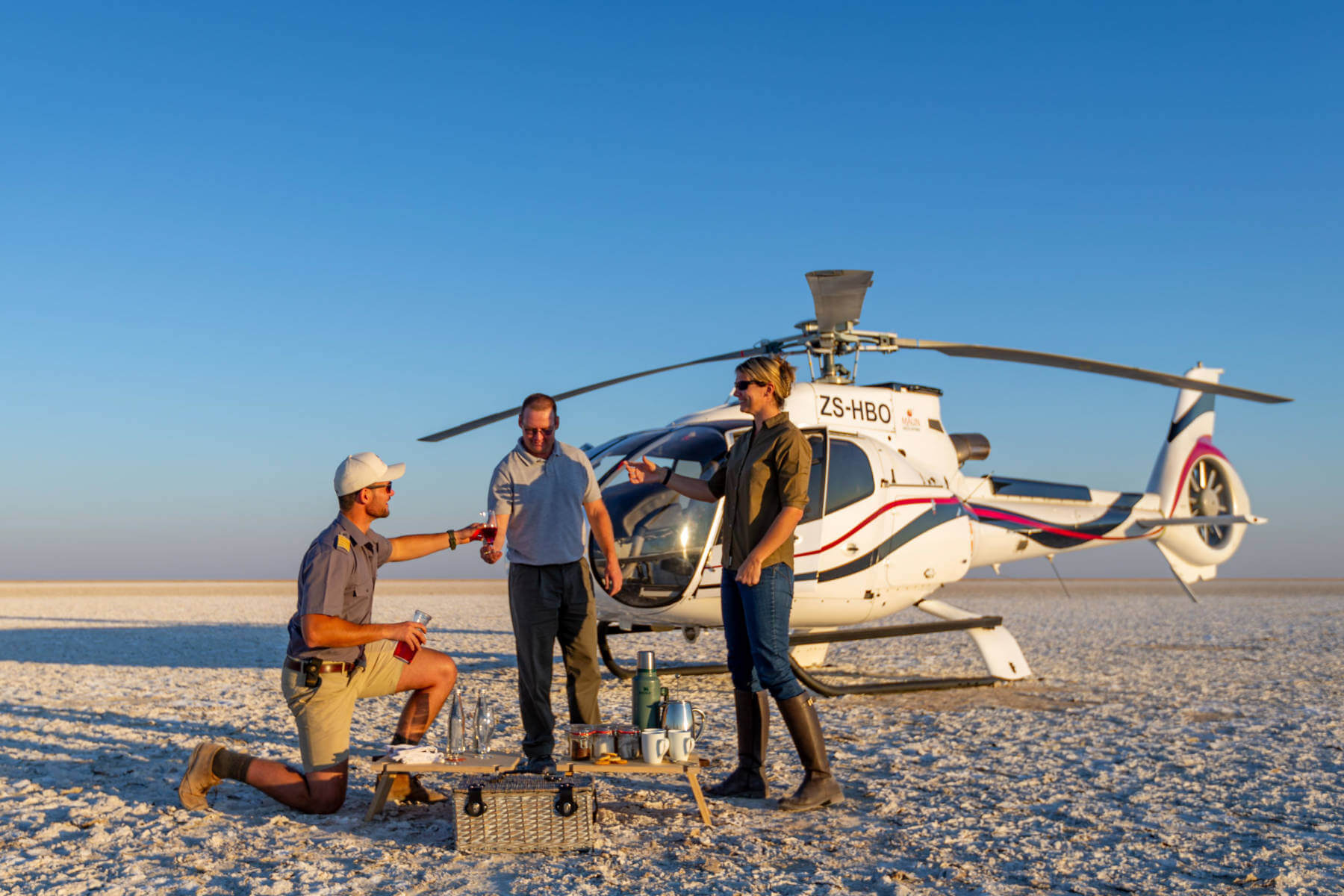
Brunch was waiting at the edge of the plateau — laid under a wide shade tree, champagne already open. I cannot tell you exactly how the chefs got it all up there, and nobody felt the need to explain. A gnarled tree branch served as the loo roll holder, and it was, without question, the finest loo roll holder I have encountered anywhere in the world.
That evening, on the drive to sundowners — cap on, Karoo turning gold, the particular contentment of someone who has eaten well at altitude — a bull elephant stepped directly into the road in front of the vehicle and stopped. Completely unhurried, aware of us, entirely untroubled by us, while a group of females moved through the bush behind him. We waited. He decided, eventually, that we could pass. We had no say in the matter. This, at Samara, is how it should be.
As the light dropped further, we went out on foot — Roelof and tracker Marno Oliphant leading through the scrub in single file — and the bush became something else entirely at ground level. “If you’re struggling to follow a track,” Roelof told me, “take your shoes off. Barefoot, you naturally choose the easiest path — and so will the animal. Stop looking for each print and think instead about where you would go.” It is a philosophy that turns out to apply to more than tracking.
He stopped not for the large things but for the small ones. He held heat close to the petals of a tiny pink wildflower and the whole thing transformed — pink to electric blue in seconds, some reaction within the plant’s pigments that science hasn’t fully explained. We tasted the fruit of a spekboom: sour, fleshy, alive. He found the plant that numbs whatever it touches — pressed a leaf to the back of my hand, sensation immediate, like a natural anaesthetic — and the sticky seed pod that attached itself to everything within reach, which generated more laughter than was probably appropriate at dusk in the African bush.
The shepherd tree he returned to more than once. White-barked, ancient, in Samara’s own logo — the bark several degrees cooler to the touch than any other shade on the reserve, which is why cheetah and lion choose to rest beneath them. He pressed his hand to it and asked me to touch the one beside it. Three degrees, minimum. In a landscape this hot and this dry, three degrees is everything.
Then, in the thicket, a white rhino. 20 metres away, on foot. No vehicle between you and it, no structure, nothing to put distance between your body and the animal’s. Just the bush, and the cooling air, and a very particular alertness that sharpens everything around you.
And then the clearing, the fairy lights, the chefs already cooking — elevated South African food, slow-cooked stew and pap, rich and deeply satisfying, the smell of it reaching us before the table came into view. There is a specific kind of hunger that a day like this produces. The food met it perfectly.
Ewert Hauptfleisch, Samara’s conservation manager, oversees the land rehabilitation work — satellite imaging, patch-by-patch intervention, a mechanical pitter plough digging thousands of water-catching holes per day. In one 34-hectare area alone, those holes now catch 165,000 litres per rainfall event that would otherwise run straight off the clay. A centimetre of topsoil takes two hundred years to build. This is perhaps the most patient dare of all — not just rewilding the animals but rewilding the land beneath them, one slow intervention at a time. Samara’s vision, meanwhile, extends well beyond its current fence lines — corridors eventually linking the reserve to Addo Elephant, Camdeboo and Mountain Zebra National Parks, one of South Africa’s largest protected areas. “You have to remain focused on what you set out to be,” Marnus told me. “The rest is just how you get there.” Twenty or thirty years of negotiation ahead, and he spoke about it the way someone speaks about a plan they fully intend to see through.
On the last evening, we drove to Plains Camp — the tented option on the reserve, wooden decks, plunge pools, canvas walls that don’t entirely block the sounds of what’s moving outside — and had sundowners as the light went gold over the Karoo. Plains Camp is rawer than the Manor, more immediate; you wake up already inside the landscape rather than stepping out to meet it. Something in me wanted to stay.
After sundowners, Roelof set up the telescope. The Karoo has almost no light pollution and on a clear night, the sky is a completely different proposition — not the sky you see from a city, or from most places in the world, but something so dense and layered it takes a few minutes to properly take in. We found Jupiter’s moons. We traced Saturn’s rings. We found galaxies beyond the Milky Way and stood there, the Karoo quiet all around, the mountains just shapes against the dark.
I found it genuinely overwhelming — the sudden, physical understanding of how small you are and how old everything else is. The Bushmen believed the white band of the Milky Way was the underbelly of a springbok. The Zulus believed the heavens were a carpet, and that shooting stars were celestial cattle moving on the other side. Standing under that sky, both felt not just plausible but right.
Sibella arrived at Samara in 2003, the first cheetah back in the Great Karoo in 130 years, having survived injuries that should have killed her — hunting dogs, beatings, a cage — through surgery, rehabilitation and what can only be described as a refusal. She raised nineteen cubs across four litters, died of natural causes at fourteen, and contributed nearly three per cent of South Africa’s entire wild cheetah population through her lineage. Not scared of humans, but not seeking them out either. She passed that steadiness to her cubs, and they to theirs — until the cheetah I stood beside on a warm afternoon in the Karoo, wild in every instinct that matters, carrying in her bloodline the memory of one who came here broken and decided, over time, to trust.
That is also rewilding. The quiet, generational kind.
I planted a spekboom before I left. Every Samara guest does — a small, drought-resistant indigenous plant with deep roots and significant carbon sequestration capacity. In 2025, guests planted around three thousand of them. Roelof handed me the tools — spade, pickaxe — and I dug my own hole, placed the plant in, pressed the soil back around it, watered it, and set the protective casing. We both looked at it for a moment.
I won’t see it mature. But somewhere in the Karoo, under that ridiculously expansive sky, my small act of daring is putting down roots.
W: Samara
Written by Emma Blunt for Luxury Safari Magazine